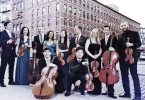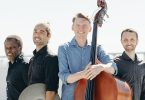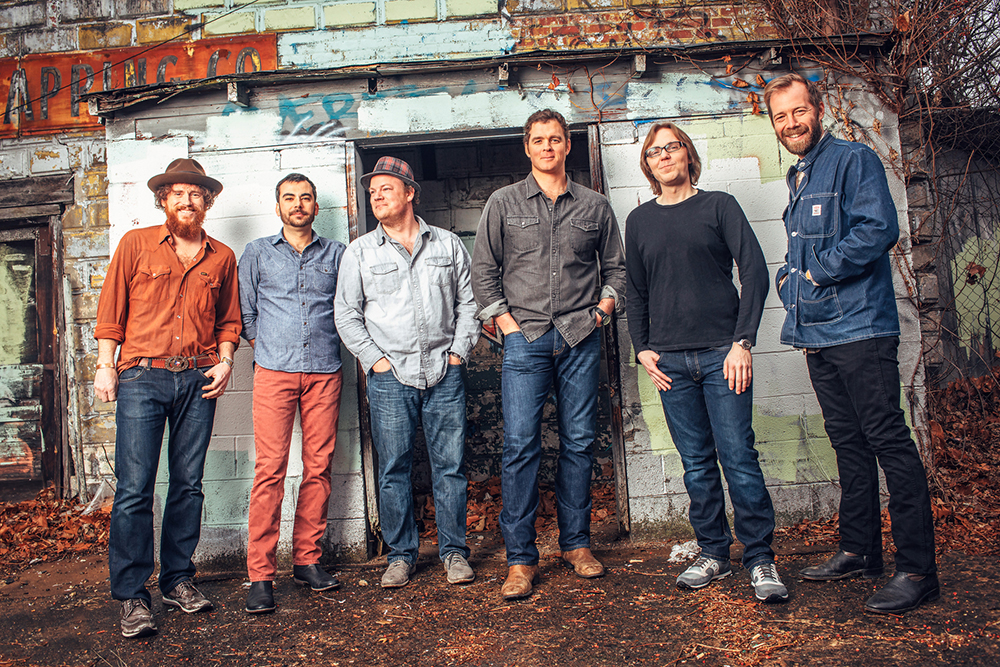
Steep Canyon Rangers (Photo by Sandlin Gaither)
If These Mountains Could Sing: Bluegrass and Old-Time Music in WNC
By Lea McLellan
It’s been a century since Englishman and folk song collector Cecil Sharp first visited Appalachia in his search for traditional English, Scottish, and Irish ballads. “He found them in a very pure form a hundred years ago in Madison County,” says Laura Boosinger, executive director of the Madison County Arts Council. “He said people there sang as naturally as they talked. So right there, you have an uninterrupted ballad-singing tradition that was held in a purer form in Appalachia than it was in England, Scotland, and Ireland.”
Remote living conditions and limited access to radio and travel contributed to the tradition of old-time music in Western North Carolina, but this is not to say that our musical ancestors didn’t offer innovations of their own. This is especially true when it comes to the banjo. With his revolutionary style of three-finger picking, Earl Scruggs earned the title “The Father of Bluegrass Banjo” and changed the face of bluegrass music forever.
“North Carolina holds the most influential players in terms of banjo playing and the development of banjo style,” says Laura. “We have clawhammer, which is a style related to the way Africans played when they brought the banjo over to America. We have an ancient two-finger style, a three-finger style popularized by Charlie Poole from Rockingham, and, of course, Earl Scruggs from Caldwell County.” Laura also mentions Bascom Lamar Lunsford, nicknamed the “Minstrel of the Appalachians,” as a major player in the scene’s history. “He collected songs, fiddle and banjo tunes, and ballads all over the region,” she says. “Twice he recorded over 300 of these pieces by memory.” Those recordings are now housed in the Library of Congress.
Earl and Bascom aren’t the only bluegrass heroes in the region. Grammy-nominated bluegrass and old-time musician and Madison County native Josh Goforth cites another figure as a major source of inspiration: the late Ralph Stanley. “I grew up with more traditional mountain music here in Madison County,” says Josh. “But when I got into high school, I started listening to Ralph Stanley. His music is a bridge between mountain and bluegrass music.”

Josh Goforth & David Holt
Josh fell in love with the sound and expanded his own musical leanings accordingly. He has since played and toured with David Holt and has shared stages with Ricky Skaggs, Bryan Sutton, The Yonder Mountain String Band, Open Road, and The Steep Canyon Rangers. “I love the rhythm of the music,” he says of bluegrass. “It’s like a train. It just keeps on rolling. I love the tight harmony singing. It reminds me of the harmony I grew up singing in church.”
There is a delightful push and pull between innovation and preservation in mountain music throughout the decades. The same mountains where traditional ballads were preserved in pure form for centuries are also the birthplace of immense musical creativity. “When Earl Scruggs and Bill Monroe basically created the bluegrass sound, that was like rock ‘n’ roll when you talk about old-time music,” says Laura. “The music always changes. It always grows, and then people go back to the purest forms because they love it so much.”
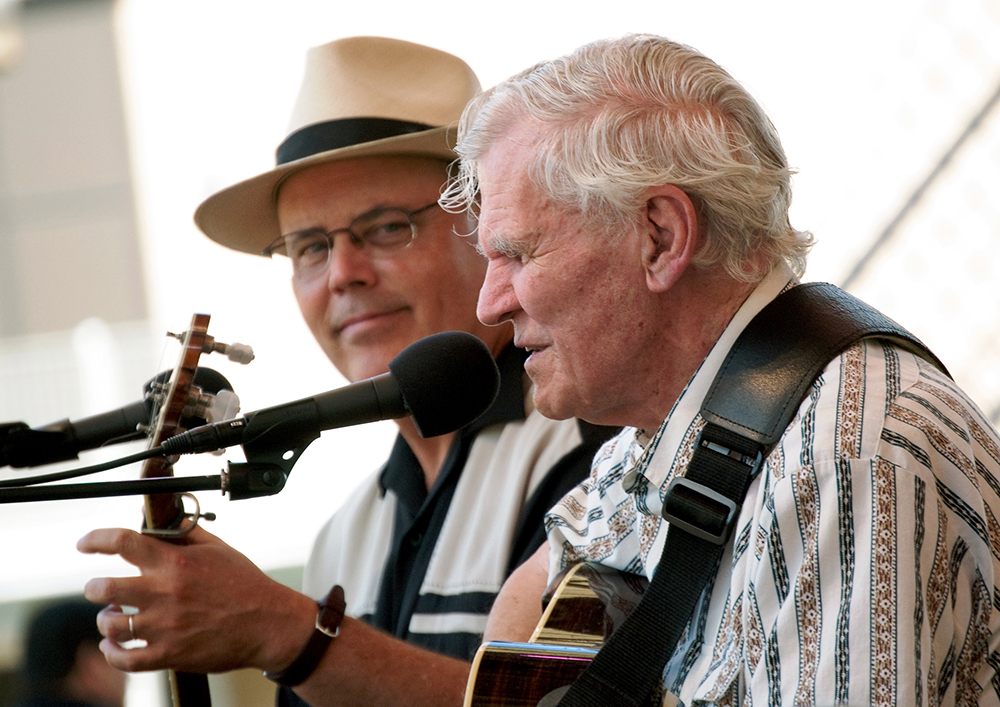
David Holt & Doc Watson
Josh, who, in addition to his own music career, teaches at the Asheville Academy for the Arts, says he sees young players continuing that path of innovation. “I think the proliferation of knowledge through the Internet is the game changer in bluegrass,” he says. “A young player can get on YouTube and watch anything being played and learn it…It’s so exciting to see where these new generations are going to take the music.” Josh also acknowledges that learning from older generations is important. “I try to encourage younger players to visit older musicians and learn from them in addition to their Internet studies because this music is about people.”
And the people who hold the keys to this style of music are right here in our own backyards. “People come to this region because they want to see our traditional music—where it was born,” says Laura. “They want to see people whose families have done it for generations. They don’t want to see Nashville’s version or Hollywood’s version. They want to see the real thing, and this where you find it: in Western North Carolina.”