David Ballard, artist
By Casey First
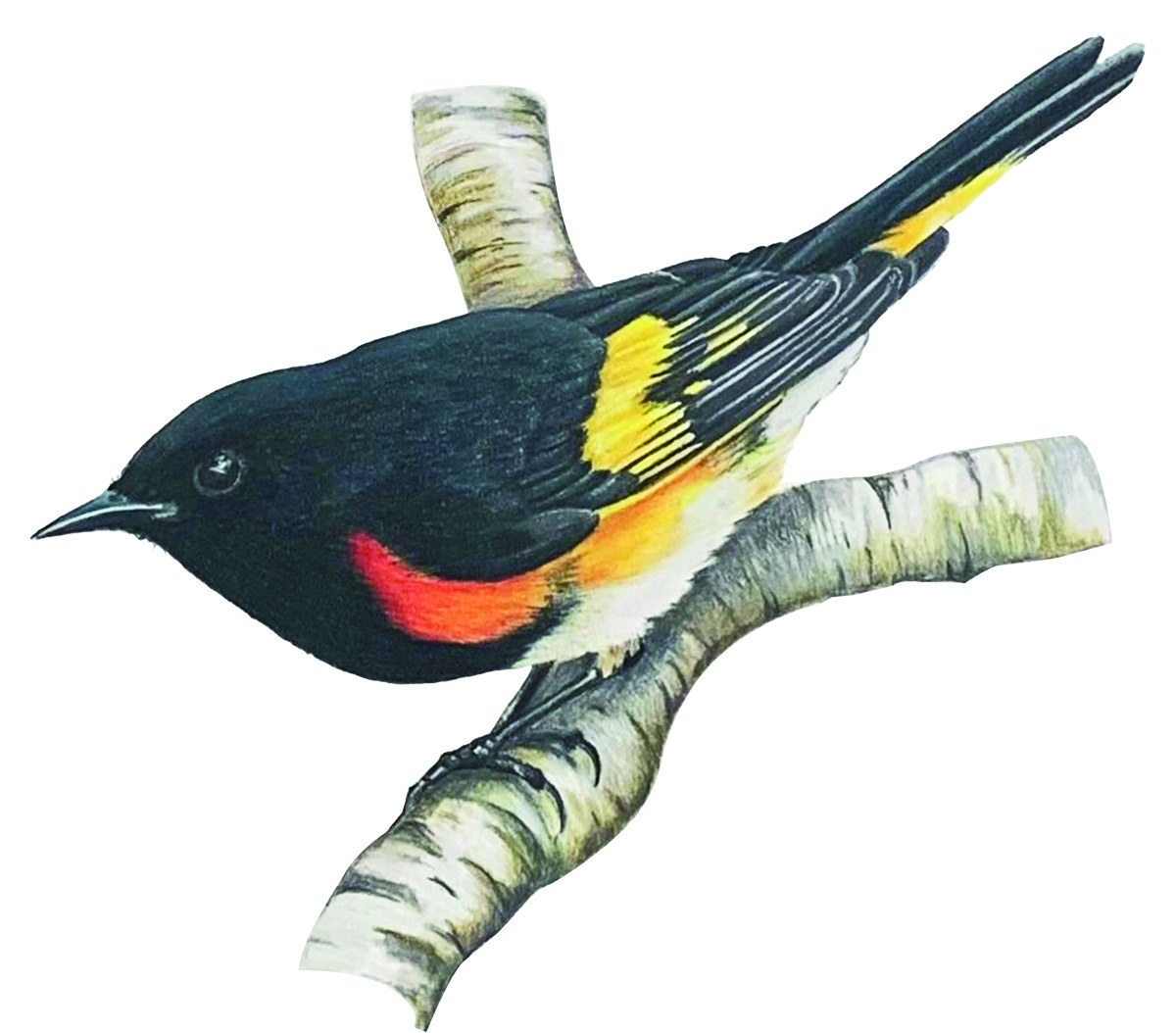
The American Redstart (Setophaga ruticilla) is a lively, medium-sized Warbler that is built like a Flycatcher. This wood Warbler has a glossy black plumage, contrasted by vivid bright patches of reddish-orange on their sides, wings and tails, and a soft white underbelly. As is the case with most bird species, the male is the more colorful of the two sexes. However, the female is equally striking, but with a gentler contrast, the dark black replaced by a softer grey and pure yellow accents.
The American Redstart is a forest bird found primarily in moist, second-growth and mixed woodlands with dense shrub layers, particularly near water or willow/alder thickets. They have a vast breeding range that encompasses much of North America, covering most of the eastern US, parts of the northwestern US and extending north to much of Canada and all the way up to Alaska.
Here in Western North Carolina, they breed in the shrubby understory of the Appalachian forests during summer, but are most often spotted during spring and fall migration (May and September). American Redstarts are considered long-distance migrants. In the winter, populations that breed in the eastern US migrate south to Florida, the Caribbean Islands and South America, while those that breed in the central US migrate south to Mexico and parts of Central America. During the winter months, these Warblers thrive in tropical lowland forests, mangroves, scrub thickets and shade-coffee plantations.
This highly specialized and acrobatic Warbler can often be seen darting from tree limb to tree limb in search of insects. They display unique foraging techniques like “sallying” (similar to that of a Flycatcher), which involves snatching prey out of mid-air.
A restless bird, they move tirelessly with quick and jerky movements. You might see them fanning and fluttering their tails to show off their vibrant and beautiful colors as a means of scaring out hidden prey buried under leaves and twigs. This gorgeous display and their elegant dances in the forest canopy, coupled with their ornate markings, is why many call them a “butterfly” in the bird world.
Mainly insectivorous, consuming flies, spiders, moths, beetles, wasps and other insects, they also eat the occasional small berry and fruit. If you have native fruit trees in your yard, be on the lookout for migrant visitors as they fuel up on their journey south in the late summer months. American Redstarts will also come to a backyard bird feeder if you offer seed blends with dried fruit and/or dried insects like mealworms.
These birds have a highly variable song pattern that can be hard to identify. If you listen for a repetitive series of musical notes, similar to a Yellow Warbler or Black-and-White Warbler they may be nearby. Their song often sounds like chewy-chewy-chewy-chew or tsit-tsit-tsit-tsit-swee.
When it comes time to nest, these Redstarts build nests in a cup shape made of tightly woven fibers in the forks of deciduous trees like birch, maple and cherry. Dad defends the territory with aerial displays, songs and posturing, while Mom lays about four eggs once a year. Once fledged from the nest (after about 10 days), Mom and Dad each attend to the new chicks by dividing up feeding duties until they can be on their own.
As with most bird species, we need to be mindful of human activity that can negatively affect populations. For these long-distance migrants, advocating for lights-out initiatives during migration and bird-friendly glass in buildings is one way to ensure these fiery birds will be around for generations to come.
Casey First is owner of North Asheville Wild Birds Unlimited, located at 946 Merrimon Avenue, Suite 120. Monthly bird events are free and open to the public, with no registration required. To learn more, visit NorthAsheville.wbu.com. Artist David Ballard lives in Candler. Find his work on Instagram at d.ballard.art.