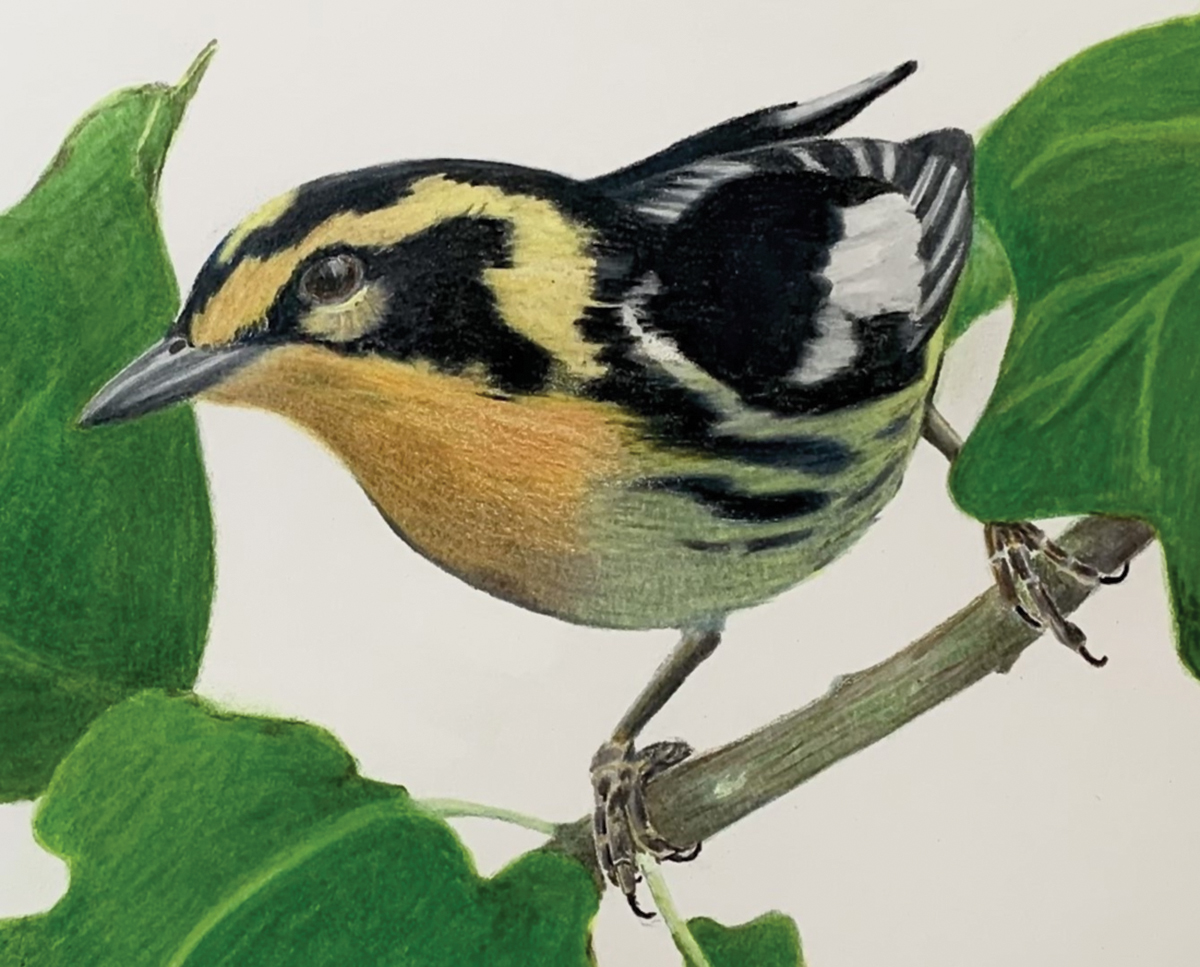
David Ballard, artist
By Casey First
The Blackburnian Warbler (Setophaga fusca) is a fiery and unmistakable little gem of a bird. Often seen perched high on the topmost twigs of large conifers in the forest canopy, this stunning songbird can be seen with its head cocked upwards, belting out a wiry song and showing off its gorgeous flaming orange throat. The orange of the male’s throat fades into a yellowy lemon underbelly and a deeper yellow crown, accented by stark black eye stripes. Their outer feathers are black with crisp white wing bars that lead back to a pointy little tail. The female is equally pretty, but has a softer yellow coat and more subdued greys throughout.
These warblers can be found in mixed deciduous-coniferous forests extending across parts of the northeastern US, down through the Appalachians, in parts of the northern Midwest and extending north into the Canadian Maritimes of Quebec and Ontario. In spring and fall, much of the eastern half of the US can view these birds as they migrate to and from their breeding grounds to their wintering homes in second-growth forests and coffee plantations in northern and western South America and parts of the Andean regions of Colombia, Venezuela, Ecuador and Peru.
This warbler can be hard to see as it seldom leaves higher canopies except during migration periods. Here in Western North Carolina, one can see these birds during summer months, mainly at higher elevations like Mt. Mitchell and Craggy Gardens.
Blackburnian Warblers are primarily insectivores and use their pointy bill to glean in leaf litter or amongst branches, filling up on caterpillars, beetles, ants, aphids and other insects. In winter and during migratory periods, they occasionally eat fruit. If you are fortunate enough to see these warblers, you can try to offer live or dried mealworms or suet. Warblers are also attracted to the sound of water, so a birdbath with a moving water feature might draw them.
Because they are often found perched high, one can almost certainly hear their unique high-pitched song before seeing them. Listen for a song that is a rapid succession of zip zip zip zip zip zip zip zip titititi tseeeeee, with a much higher pitched final note that can reach the limits of the human ear. Many older adults have a hard time detecting it. One of their calls is a sharp tsip often heard during spring and fall migration.
Nests are built as high as 100 feet off the ground in the dense coniferous woods they inhabit. Closer to home in our Appalachian Mountains, nests can be found in hemlock and spruce forests. The female will build a cup-shaped nest in the dense foliage in a fork on the outermost branches of the tree. Constructed of twigs, bark, spider silk and plant fiber, she lines it with soft mosses and hairs to nestle the three to five eggs she will lay once per year. Once fledged, the young birds have been known to forage in flocks with other small songbirds like nuthatches, chickadees and kinglets.
The Blackburnian Warbler population has remained strong over the past 50 years, causing no real conservation concern. However, as with all bird species, deforestation and commercial pesticide use are common threats that must be controlled for healthy long-term population forecasts.
Casey First is owner of North Asheville Wild Birds Unlimited, located at 946 Merrimon Avenue, Suite 120. Monthly bird events are free and open to the public, with no registration required. To learn more, visit NorthAsheville.wbu.com. Artist David Ballard lives in Candler. Find his work on Instagram at d.ballard.art.