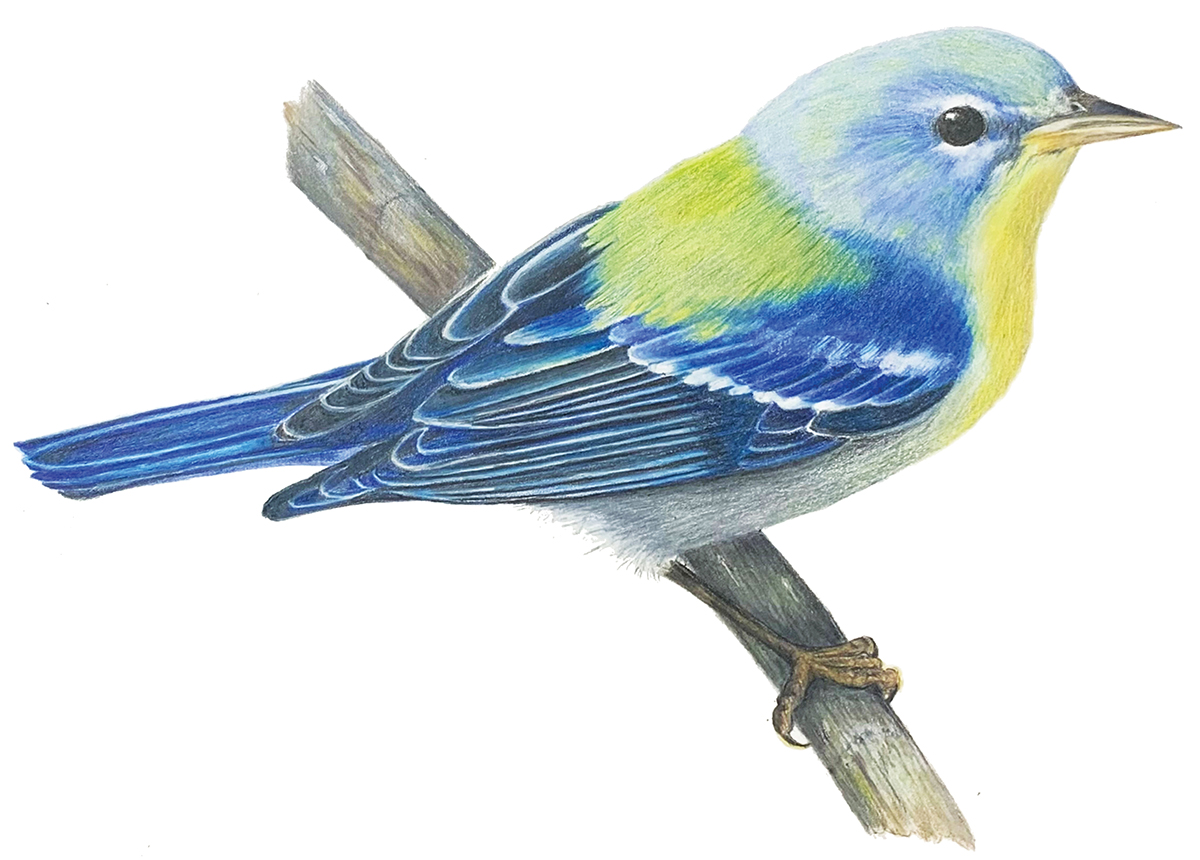
David Ballard, artist
By Casey First
The Northern Parula (Setophaga americana) is one of North America’s most petite and delightful warblers. This tiny, plump songbird provides a splash of yellow in the dense upper canopy. The adults are bluish gray with a yellow throat and upper chest, a white belly, two white wing bars and distinctive white crescents above and below the eye. They also have a unique yellow-olive patch in the center of their back. Both male and female have a chestnut and black breast band; however, the female’s is not as pronounced. These wood-warblers also have a short, pointy tail and a thin, bicolored bill that has a tweezer-like shape designed for gleaning insects from dense tree foliage.
Northern Parulas breed across much of eastern North America, from the Southeast into the Northeast and parts of Canada, and winter in Mexico, the Caribbean and parts of Central America. Interestingly enough, they have an odd break in their breeding range, skipping much of the Midwest and parts of the Northeast. The primary reason for this has to do with habitat loss and increasing air pollution, which affects the growth of the fine moss on which they rely. Their preferred habitat is in humid woodlands, though they also use wooded swamps, pond edges, stream corridors and mixed woodlands. In the Western North Carolina mountain region, they breed from early April to mid-October.
The Northern Parula utilizes its pointy bill to prey on insects like caterpillars, beetles, flies, moths, ants, bees, wasps, spiders and other tiny arthropods. Although primarily an insectivore, it will also eat fruit on occasion. The Parula forages in the canopy and subcanopy, moving along branch tips, hovering to pick prey from leaves, and sometimes hanging upside down like a chickadee. Because of this, spotting them is not the easiest, and many who try will succumb to “warbler neck.” However, during migration, these birds feed lower in the woods, making them a little easier to spot and giving your neck a break.
A Northern Parula typically does not come to a backyard bird feeder. Focus on planting native trees and shrubs to supplement their diet or try offering moving water so they can cool off during migration. Perhaps you can get lucky and hear these birds in your backyard. If you hear a rising, buzzy trill that ends with a sharp, abrupt chirp (like a zipper), they may be nearby. If your yard has mature trees with hanging lichen, you set yourself up for the best chances as this is prime Parula territory.
Parulas breed in mature forests where epiphytes are present, especially Spanish moss in the Southeast, and old man’s beard in the Northeast. Nesting begins in March in the southern part of their range, and May in the north. Nest sites are suspended over water, usually in hanging vegetation clumps made of lichen, moss, twigs, grasses, pine needles and hair, high above the ground. Mama Bird will have one to two broods per season, laying up to six eggs.
The good news for us is that this marvel of a warbler is not at risk for population decline. As always, we need to be mindful of their delicate ecosystem and take measures to prevent habitat loss and forest degradation.
Casey First is owner of North Asheville Wild Birds Unlimited, located at 946 Merrimon Avenue, Suite 120. Monthly bird events are free and open to the public, with no registration required. To learn more, visit NorthAsheville.wbu.com. Artist David Ballard lives in Candler. Find his work on Instagram at d.ballard.art.