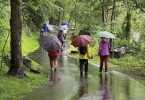
Fairview Community Forest. Photo by Derek DiLuzio

A new network of public trails is taking shape in Fairview at the Fairview Community Forest, where 226 acres of protected land owned by Conserving Carolina are being prepared for public access. When the forest opens in spring of 2026, several miles of hiking and mountain biking trails are expected to be ready for public use, with additional routes added over time.
The community forest surrounds the WORX Project, an outdoor learning program serving middle and high school students from Asheville and B
Sara Jarrell, director of the WORX Project, says having the land permanently protected changed how students experience the program.

Garden at the WORX Project. Photo by Derek DiLuzio
“Once the land was conserved, everything shifted toward permanence, stewardship and depth,” says Jarrell. “Students now learn on land they know will remain intact for generations, which changes how they relate to it. They can return to the same trails, wetlands and work sites over months and years, observing seasonal cycles, ecological change and the long-term impact of their own decisions. That continuity makes learning more experiential, reflective and responsibility-driven.”
Place-based learning is central to the WORX Project’s mission. Designed to look very different from a traditional classroom, the program blends career and technical education with science, technology, engineering, arts and math, alongside social-emotional learning. Rather than specializing early, students rotate through a wide range of hands-on experiences, gaining exposure to different skills, industries and ways of working.
In practice, that means students might spend one week turning fallen trees into usable lumber, the next preparing meals in an outdoor kitchen and another repairing bicycles, sewing outdoor gear from recycled materials or learning about environmental stewardship through gardening, beekeeping and birding.
This year, trail construction will become part of the curricula as well.
“Students will learn how to design, build and maintain sustainable trails from the ground up,” says Jarrell. “That starts with reading the landscape—understanding slope, soil type, drainage and how people and wildlife move through the area. From there, students plan trail routes, flag lines, measure grade and learn how small design decisions can prevent erosion and long-term damage.”

WORX Project participant with crayfish. Photo by Kiko Salazar
When complete, the Fairview Community Forest trail system will give residents a nearby place to walk and ride, with routes designed for beginner-to-intermediate hikers and mountain bikers. A bathroom facility is planned as part of a later phase, making the forest more accessible for families and longer visits.
For Conserving Carolina, the project reflects a broader vision for conservation.
“The active use of the forest will be amazing, but the land’s passive role is equally impressive,” says Tom Fanslow, the nonprofit’s land protection director. “The property ranked in the top four percent of high conservation priorities in the watershed, and Tropical Storm Helene was the acid test.”
According to Fanslow, the acreage forms a forested bowl perched near the top of the Continental Divide. Thanks to its intact tree canopy and healthy soils, the land absorbed a vast amount of rainfall during Helene, and an existing dam dramatically slowed runoff, reducing downstream impacts. “It was a job well done,” he says.
Beyond its environmental value, Jarrell hopes the forest continues to shape how students see themselves and their role within the community.
“Ultimately, learning about forests and working landscapes in a classroom is valuable, but learning with them is transformative,” they say. “Physical engagement creates deeper understanding, stronger skill development and a lasting connection to the land that shapes how students see their role in the world long after they leave WORX.”
To learn more about Conserving Carolina, visit ConservingCarolina.org.