By Elaine Smyth
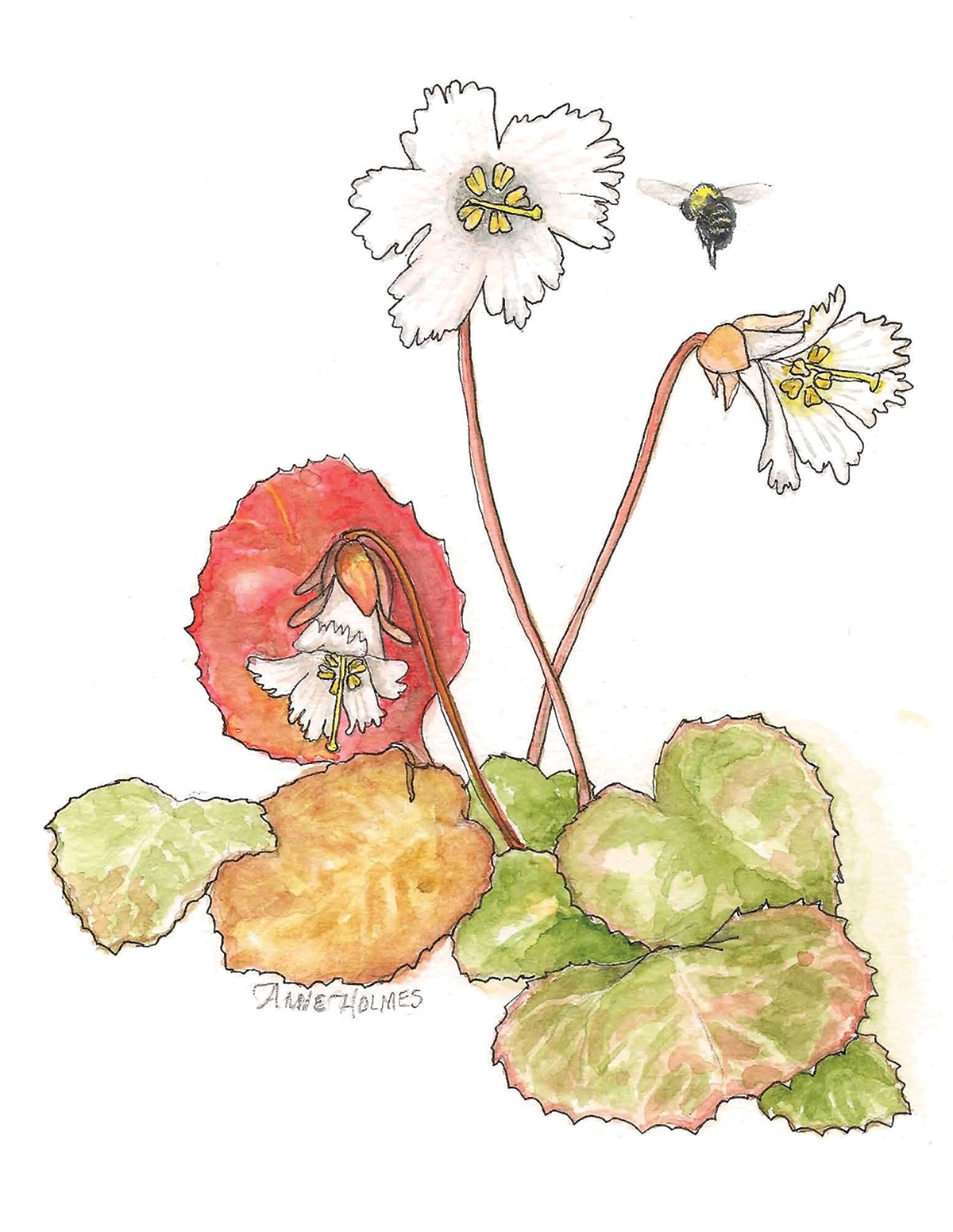
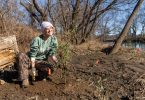
Anne Holmes, artist
Beautiful and delicate, the creamy white flowers of Oconee bells, Shortia galacifolia, are a highlight of early spring in Asheville Botanical Garden. Blooming along the upper Crayton Trail, the bell-shaped flowers with scalloped petals emerge from beneath the evergreen, heart-shaped leaves, sometimes in late February, but most often in early March. The silver-veined leaves resemble those of galax, and like galax, they turn red and bronze during cold weather. Beautiful in every season, Shortia makes a wonderful ground cover once established, but it is a very challenging plant to grow and is seldom found for sale. Known only in a few locations in the Southern Appalachians, it is endangered throughout its range.
The history of Shortia in botany is noteworthy, as it was the focus of intense interest during the 19th century. Shortia was first collected for scientific purposes as a nameless specimen by French botanist and explorer André Michaux in 1788. Visiting Paris in 1839, Asa Gray, then America’s most prominent botanist, saw Michaux’s dried specimen—consisting only of leaves, no flowers—and recognized it as a new species.
He named it after Charles Wilkins Short (1794-1863), a fellow botanist and medical doctor in Kentucky. Gray’s discovery launched him on a decades-long hunt to find the plant in bloom—a hunt that was stymied until 1878, when an herbalist in McDowell County sent Gray specimens located there. Gray was thrilled and memorably exclaimed, “Now let me sing my Nunc Dimittis,” upon finally receiving the live specimen.
Shortia was indeed important, because Gray’s comparison of it to related species in Japan led him to support Darwin’s theories of evolution—a large historical role for this diminutive, much-loved harbinger of spring.
Upcoming Events at Asheville Botanical Garden
Sunday, March 1: Propagating Native Woody Plants from Cuttings, with Emily Driskill
Tuesday, March 3: Certified Pollinator Advocate Series: Gardens That Please Both People AND Pollinators, with Amy Fahmy
Saturday, March 7: North Carolina Native Plant Society Land of the Sky Chapter Meeting
Sunday, March 8: Tree Identification Walk, with Luke Cannon
Saturday, March 14: Using Native Grasses and Sedges in the Garden, with Nancy Adamson
Saturday, March 21: Bird-Friendly Gardening, with Tom Tribble
Sunday, March 22: Small Wonders in Spring: A Moss and Lichen Walk, with Sue Studlar
Saturday, March 28: Introduction to Lawn Alternatives for HOAs
Learn more and register for classes online via the ABG website at AshevilleBotanicalGarden.org.
The ABG Visitors Center and Gift Shop is open 10 a.m. to 4 p.m. daily, featuring work by local artisans, garden-themed art, toys, tools, cards, and books. Asheville Botanical Garden, 151 W.T. Weaver Boulevard, is an independent nonprofit showcasing more than 750 species of native plants in a 10-acre naturalistic setting. Our mission is to promote and showcase the value and diversity of plants native to the Southern Appalachian region by serving as an educational resource and urban destination for nature study and enjoyment. Supported by members, donors and volunteers since 1960, the Garden is free to all and open daily from sunrise to sunset, year-round.