By Suzanne Wodek
Nyssa sylvatica, commonly called black gum, is a medium-sized, native deciduous tree in the Nyssaceae family. It can be found in the hills and mountains, on dry slopes with oaks and hickories, and occasionally in bottomlands, swamps and depressions that are sometimes flooded. The black gum is grown as an ornamental for its beautiful, scarlet-red fall color and for its shiny, dark green leaves in the summer.

Anne Holmes, artist
The genus name, Nyssa, is derived from the word Nyssa or Nysa, the place where water nymphs of Greek mythology raised Dionysus. The specific epithet, sylvatica, means “of the woods.”
Black gums reach a mature size of 40 to 70 feet tall, but typically grow to 20 to 30 feet in cultivation. Slow-growing, it reaches 12 to 15 feet in about 10 years. It grows faster with a good watering and fertilizing schedule. Trunk diameter is typically 1 to 2 feet, but can reach 4 to 5 feet in taller specimens. The tree prefers average, medium to wet soils in full sun and moist, acidic soils, but is adaptive and tolerates poorly drained soils and standing water, some drought and some dry soils.
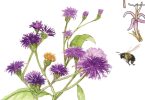
It has a flowering habit that is dioecious, meaning a male and female tree are required to produce fruit. However, some plants have mostly male flowers while others have mostly female flowers. This would account for some plants being loaded with egg-shaped, blue-black berries, while others may only have a few berries. Female trees need a male pollinator to set fruit. The nectar from the flowers is sought after by bees and Tupelo honey is highly prized.
This tree is an excellent choice to support wildlife in the landscape. However, it should be sited in a permanent location because its long taproot makes it difficult to transplant later. Though tolerant of drought, heat, and dry or wet soils and moderately salt-tolerant, it is intolerant of alkaline soils. The spectacular fall foliage color will add interest to your landscape.
The Asheville Botanical Gardens, located at 151 W.T. Weaver Boulevard, is a nonprofit housing a collection of plants native to the Southern Appalachian mountains. Gardens are open sunrise to sunset. The gift shop carries garden-themed items and books, and is open from 10 a.m. to 4 p.m. Admission is free, but donations are appreciated. Membership benefits include a discount of 10 percent on purchases in the Gift Shop, an exclusive collection of gardening and nature books in the Cole Library that members can check out (reference collection not included), our quarterly New Leaf newsletter, and tours and programs at a reduced rate. Learn more at AshevilleBotanicalGarden.org.