Anne Holmes, artist
By Elaine Smyth
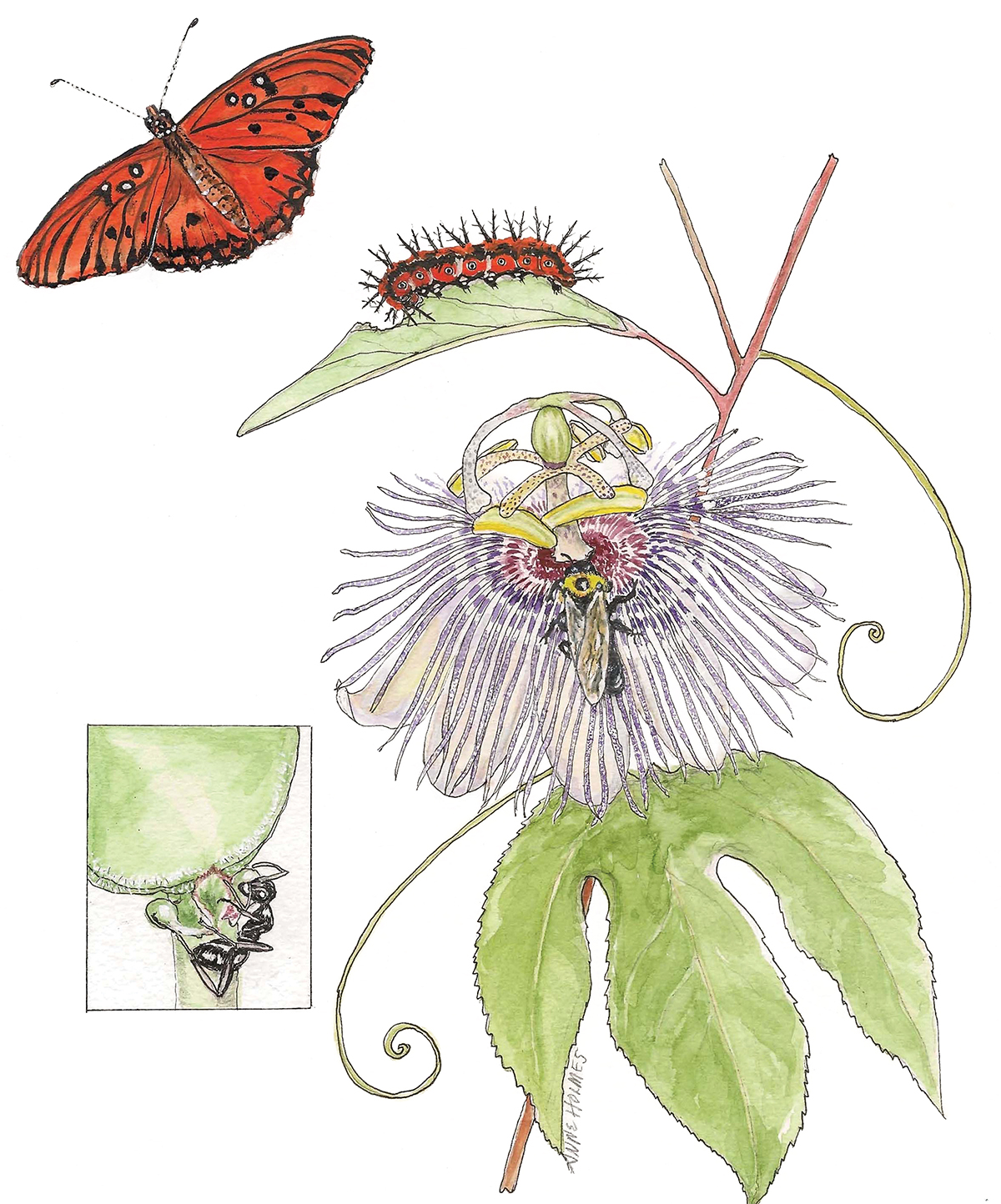
It would be hard to find a flower more ornate, bizarre and visually complex than our native purple passionflower, Passiflora incarnata. Each blossom looks something like an alien decked out in a feather boa: its protuberant anthers and pistil are surrounded by a fringe of bright corona filaments forming a starburst pattern that attracts its favorite pollinator, the carpenter bee. Also known as maypop or apricot vine, it is a member of the passion vine family or Passifloraceae, which includes some 750 species native to the western hemisphere.
It’s a fascinating plant in other ways, as well, in that it produces extra-floral nectaries. These sugar-producing glands grow on the leaves, petioles and stems of some plants, having evolved through a mutualistic relationship with insects, especially ants, which actively defend the plant against herbivores. Furthermore, recent research conducted by Dr. Shawn Krosnick and her students at Tennessee Technological University has shown that in addition to recruiting ants with extra-floral nectaries, some species of passionflowers have evolved structures that exactly mimic the size, shape and color of butterfly eggs, thus discouraging visiting butterflies from laying more eggs that soon become vine-eating caterpillars.
Butterflies are, in fact, one of many reasons that gardeners grow purple passionflower, despite its aggressive, spreading growth habit. It is an important larval host plant for the Gulf Fritillary (Agraulis vanillae), the Variegated Fritillary (Euptoieta claudia) and the Zebra Heliconian (Heliconius charithonia), all migratory butterflies that winter south of here. It’s a magnet for many butterflies and bees, and even hummingbirds drink nectar from the flowers in the summer. In addition, its pulpy, egg-sized fruits are eaten by songbirds and small mammals.
Humans, too, make use of the plant as fruit and medicine. In our region, Cherokee people ate the fruits raw or crushed them into a juice, cooked young shoots with other edible greens and used decoctions from pounded roots for skin problems, liver ailments, earaches and weaning babies. Large quantities of passionflower seeds have been found at the Berry archaeological site at Joara, once a large Native American settlement (near present-day Morganton), where Captain Juan Pardo built Fort San Juan in 1567.
Indeed, it was early Spanish missionaries in the Americas who gave the plant the name we use today. In its intricate flower, they saw a symbolic representation of the Passion of Christ: a crown of thorns made up of corona filaments; ten sepals and petals that symbolize the disciples who remained faithful; three upper stigmas representing nails; and five lower anthers signifying wounds. Today, various preparations made from passionflower leaves are readily available and are prized for their calming properties, despite the flower’s extravagant appearance and its perfervid name.
Upcoming Events at Asheville Botanical Garden
Learn more and register for classes online via the ABG website at AshevilleBotanicalGarden.org.
Tuesday, July 7: C.P.A. Series: All About Butterflies & Moths, with Sharon Mamoser
Saturday, July 25: Cut Flower Gardening with Native Plants, with Leonora Stefanile
The ABG Visitor Center and Gift Shop are open 10 a.m. to 4 p.m. daily, featuring local products, garden-themed art, toys, tools, cards and books.
Asheville Botanical Garden, 151 W.T. Weaver Boulevard, is an independent nonprofit public garden showcasing 750+ species of native plants on 14 acres. Its mission is to promote and showcase the value and diversity of plants native to the Southern Appalachian region by serving as an educational resource and urban destination for nature study and enjoyment. Supported by members, donors and volunteers since 1960, the Garden is free to all. The Garden is open daily, sunrise to sunset, year-round.