By Elaine Smyth
The Heath Family (Ericaceae) includes many of Western North Carolina’s most spectacular and characteristic flowering plants, including rhododendrons, azaleas and mountain laurel. With their extravagant blossoms, they provide an endless floral display from mid-spring through mid-summer, from the glorious flame azaleas at the North Carolina Arboretum to Roan Mountain’s spectacular June showing of Catawba rhododendrons. But these showstoppers have a more modest, unassuming cousin that will be blooming soon: trailing arbutus, or Epigaea repens.
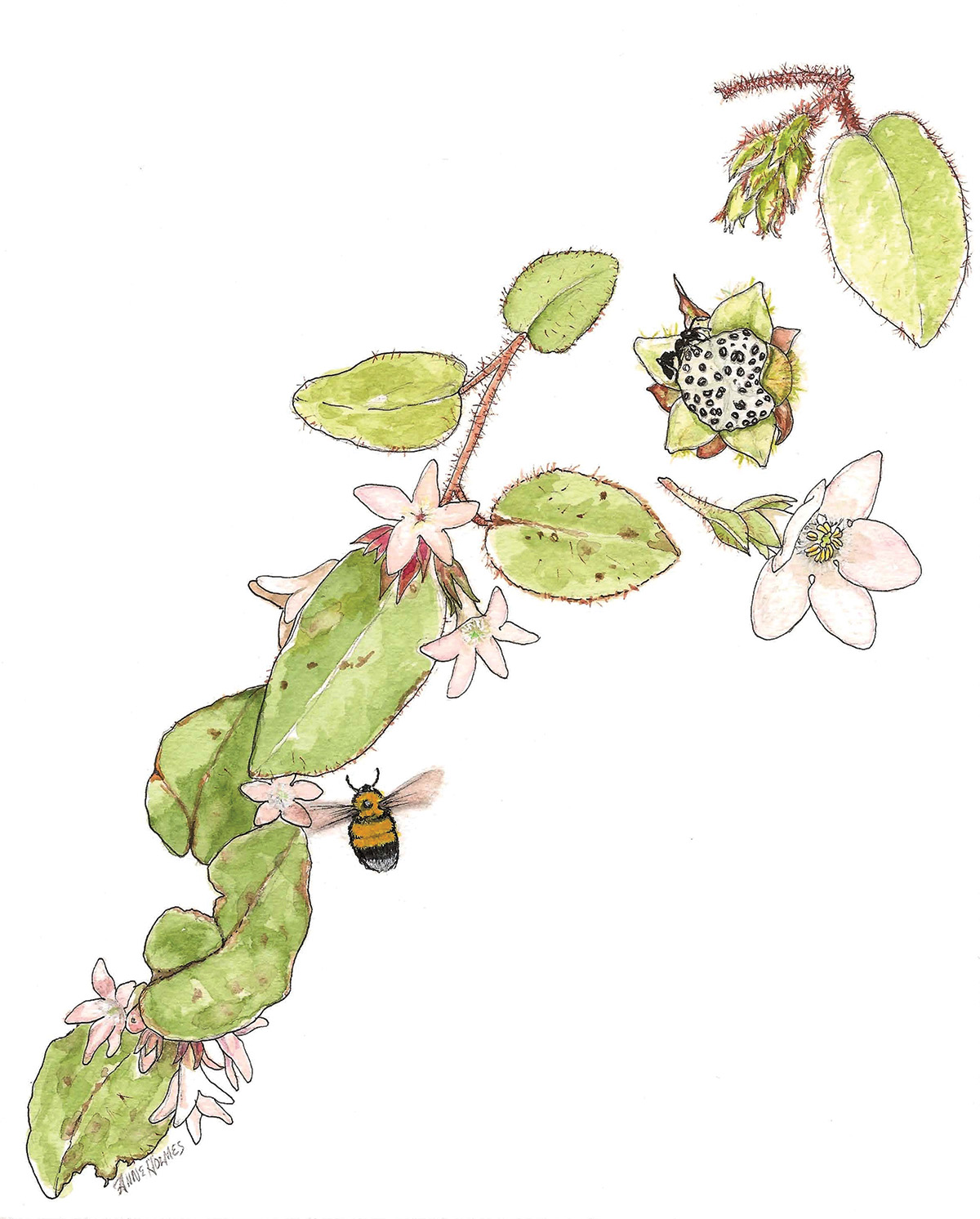
Anne Holmes, artist
Also known as “mayflower,” trailing arbutus is a low-growing native shrub with leathery, aromatic leaves that grows best in part shade, with an affinity for rocky, forested ridges, such as those found on the Appalachian Trail in the Hot Springs area. Very early in spring, it produces clusters of trumpet-shaped pink to white flowers with an exquisite fragrance. More common in New England, trailing arbutus is hard to find in our woods, where it is at its southern limit. Indeed, it’s known as a “belly plant”—one you must get down on the ground to find and enjoy.
The plant has a rich history of human usage, despite its small size and unpretentious habit. The Cherokee people used the plant in a variety of preparations to treat abdominal, kidney and chest ailments. Early European immigrants to New England heralded it as a symbol of hope at the end of their first terrible winter in what was, for them, a challenging New World.
Trailing arbutus is best appreciated in the wild, as it is very difficult to raise from seed and almost impossible to transplant because it depends on mycorrhizal associations for good health. The seeds of trailing arbutus—like those of trout lilies, trilliums, bloodroots and Dutchman’s breeches—include elaiosomes, small packets of lipids and proteins that are an irresistible treat for foraging ants, who disperse the seeds by carrying them back to their nests. In the wild, trailing arbutus is important as an early source of food for queen bumblebees as they emerge in spring.
Upcoming Events at Asheville Botanical Garden
Learn more and register online via the ABG website at AshevilleBotanicalGarden.org.
Free event! Shade Your Stream: Stabilizing Eroding Stream Banks with Native Plants, with Sarah Noah
Sunday, February 1, 2–3:30 p.m.
Certified Pollinator Advocate Series: Battle Plans Against Exotic Invasive Plants, with Raven Sterling
Tuesday, February 3, 6–7:30 p.m.
The ABG Visitors Center/Garden Path Gift Shop is open 10 a.m. to 4 p.m. daily, featuring local artists and artisans, garden-themed art, toys, tools, cards and books.
Asheville Botanical Garden, 151 W.T. Weaver Boulevard, is an independent nonprofit including more than 750 species of native plants in a 10-acre naturalistic setting. Our mission is to promote and showcase the value and diversity of plants native to the Southern Appalachian region by serving as an educational resource and urban destination for nature study and enjoyment. Supported by members, donors, and volunteers since 1960, the Garden is free to all. Open daily from sunrise to sunset, year-round.