By Suzanne Wodek
Houstonia purpurea (formerly Hedyotis purpurea) is a native species of flowering plant in the coffee family. Common names include Venus’ pride, woodland bluet and purple bluet. Clusters of three or more blooms grow on hairy stems about 20 inches tall. The flowers have four lavender-blue to almost white petals that fuse into a deep tube. Usually the central flower opens first.
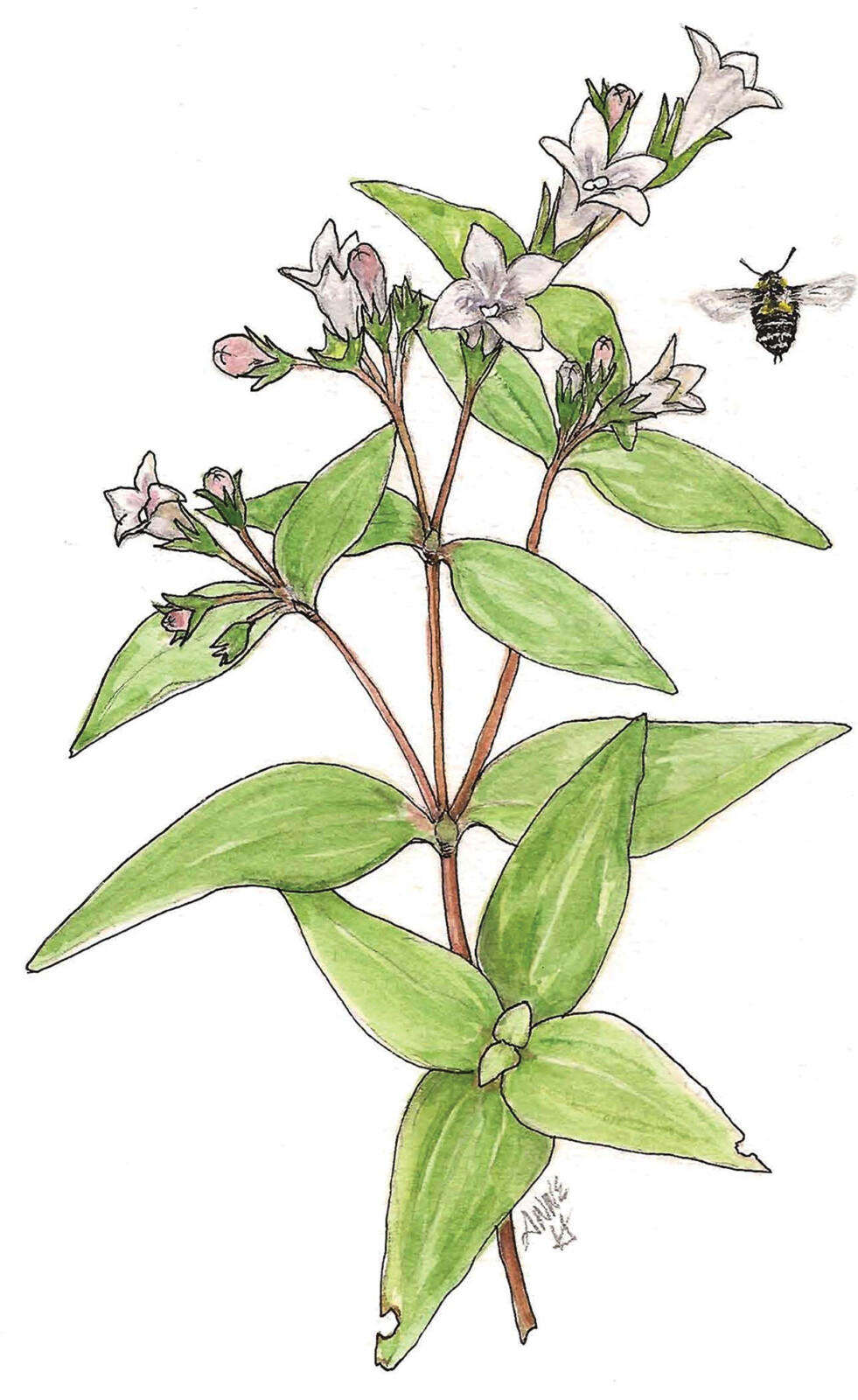
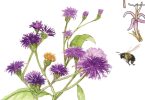
Woodland Bluet. Anne Holmes, artist
Of the three varieties of the species, the rarest is Roan Mountain bluet, a federally listed endangered species. It occurs only in the southern Appalachians along the border between Tennessee and North Carolina. It is named for Roan Mountain, one of a very few mountain peaks where it grows. In its natural habitat, it can be found in many locations, such as well-drained slopes, hardwood floodplains, moist woods, rocky upland forests, rocky bluffs, pastures, limestone glades and along streams and lakes.
This plant was named in honor of William Houstoun (Houston) (1695-1733), a Scottish physician and botanist. He was a ship’s surgeon who collected and wrote about plants in Mexico and the West Indies.
Upcoming Event
Identifying Those Many Plants and Wildflowers of the Southern Blue Ridge with Bernard Arghiere
Sunday, May 21, 1–4 p.m.
Meet at BGA Visitor Center for this indoor and outdoor class.
Here in the Southern Blue Ridge, we live in one of the most diverse temperate plant communities in the world—with more than 2,500 species of flowering plants and about 130 different tree species. But how do you begin to identify this entire flora? In this beginner class, you will be introduced to many of the tools and methods for identifying plants in our area, including plant classification systems, phone apps, “keying” guides, flower and tree guidebooks and basic botanical terminology. Using the information learned in the classroom session, you will then spend time identifying some of the native plants at the Botanical Gardens.
Arghiere has studied the wildflowers and plant communities of the southern Blue Ridge for more than 30 years. He completed the Blue Ridge Naturalist program in 2013, and he has taught at UNC-Asheville’s Lifelong Learning Institute since 2006, including many classes on wildflowers. He serves on the board of the Botanical Gardens at Asheville and as a trustee on the board of the North Carolina chapter of The Nature Conservancy.
Cost is $35 for non-members and 25 percent off for BGA members. Space is limited. Register online at AshevilleBotanicalGardens.org.
Botanical Gardens, located at 151 W.T Weaver Boulevard, is a non-profit organization housing a collection of plants native to the Southern Appalachian Mountains. Gardens are open from dawn to dusk. The gift shop is open from 10 a.m. to 4 p.m. Admission to the Gardens is free, but donations are appreciated and memberships are encouraged. Membership benefits include a discount of 10 percent on purchases in the gift shop, an extensive collection of gardening and nature books in the Cole Library that members can check out (reference collection not included), our quarterly New Leaf newsletter, and tours and programs at a reduced rate. Learn more at AshevilleBotanicalGardens.org.