Photo by Jonathan Marchal
By Emma Castleberry
Join cities across the globe for the City Nature Challenge, a citizen science project starting on Friday, April 28. This international effort encourages individuals to observe and record as many plant and animal species as possible at the same time each year. “By comparing the data from year to year we can determine how populations may be changing in response to changes in their environments,” says Jonathan Marchal, director of education at The North Carolina Arboretum and a leader for Team WNC in the City Nature Challenge. “This could be changes in the number of individual organisms in a particular location, the time of year they may be observed or if new populations may be moving to new areas. You can think of the City Nature Challenge as a snapshot in time of biodiversity.”

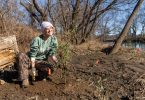
Bruce and Harper Marchal searching for salamanders and aquatic insects in Bent Creek.
There are two parts to the City Nature Challenge. Between Friday, April 28, and Monday, May 1, participants take pictures of as many wild plants and animals as they can find, noting the location and uploading their findings to iNaturalist or a similar program chosen by their city. Participants can engage as individuals or as part of their city or regional team. The second part of the challenge happens between May 2 and May 7, when the observations are identified and catalogued. Results are announced on May 8. There is a friendly competition element to the challenge, with cities ranked according to number of observations, species and participants. “Western North Carolina is prized for its tremendous biodiversity and I’d love to see us shine bright in that category,” says Marchal.
The WNC region joined the challenge in 2019 with 5,667 observations of 1,212 species made by 321 observers. Last year, this region submitted 7,791 observations of 1,757 species made by 755 observers. Marchal says one of the more interesting pieces of data from the City Nature Challenge is which species are observed the most. Last year, red trillium and painted trillium were among the most observed species, along with 19 separate warbler species, as well as an Eastern hellbender, a timber rattlesnake and an Eastern screech owl.
“People are surprised when they realize their everyday, ordinary observations can be important to scientists,” says Paige Engelbrektsson, lead education specialist at Highlands Biological Foundation and an advocate for the City Nature Challenge. “The City Nature Challenge also helps the participants to connect to the places that they live in. Taking the time to stop and smell the flowers, and then share them with the global scientific community, encourages people to notice and learn more about the wildlife that they see.”
While it’s called the City Nature Challenge, observations do not have to be made within a city. Twenty nine counties are included as part of the Western North Carolina region and any observations uploaded to iNaturalist within these counties during the challenge’s timeframe will be counted. “Anyone at all can be a part of species conservation,” says Marchal. “Species that we all know and love, like monarch butterflies, for example, are on the decline. For many species this is due to habitat loss and the results of climate change. However, rather than feeling powerless to help this cause, anyone can provide observations of the plants, animals and other species that they find by taking part in the City Nature Challenge. This helps us not only establish an understanding of what is happening currently but also document where populations may need to be reestablished in the future.”
To learn more about the challenge, visit CityNatureChallenge.org. Find Team WNC’s iNaturalist project at iNaturalist.org/projects/city-nature-challenge-2023-western-nc. You will need to create a simple, free account to upload observations and participate. North Carolina participants are eligible for a free NC BioBlitz patch from Science Across NC. Visit ScienceAcrossNC.org. Young people ages 5-13 can also earn a BioBlitz badge via ecoEXPLORE, and can register for this free year-round science and nature enrichment initiative of the Arboretum at EcoExplore.net.