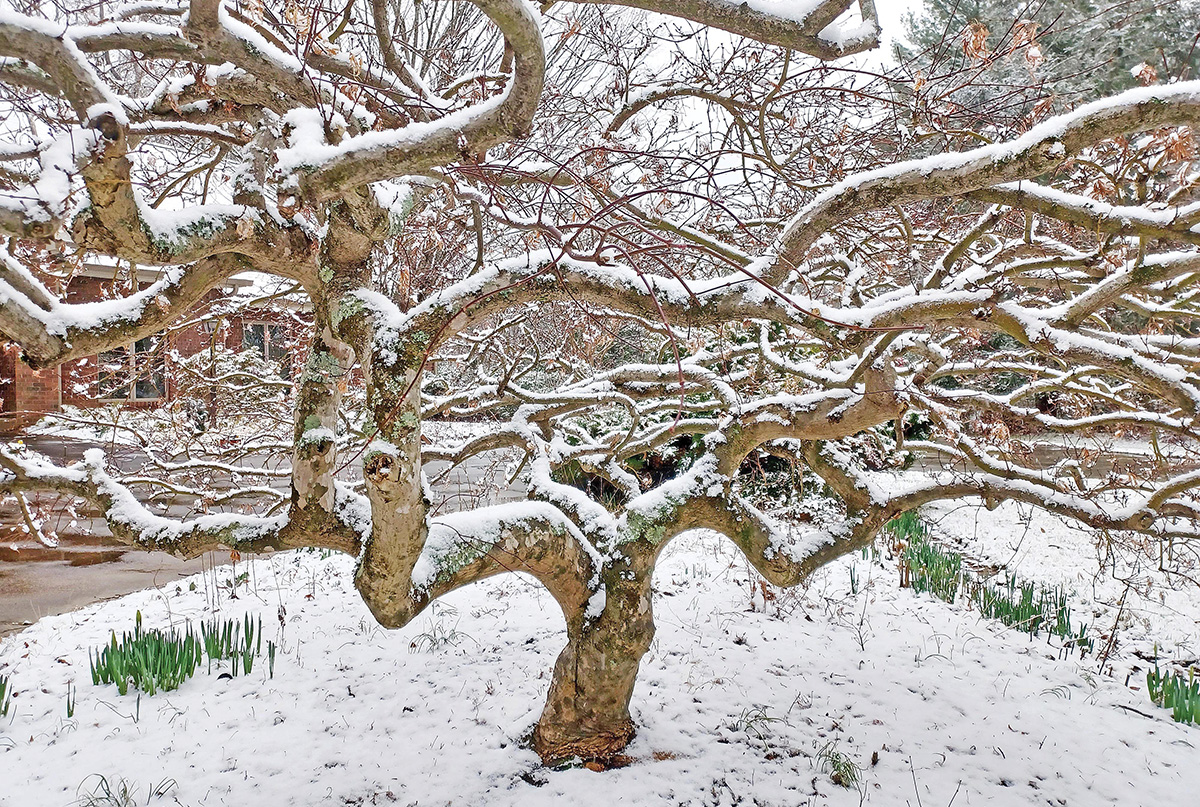
Dwarf Japanese Maple. Photo by Judith Canty Graves
“Every gardener knows that under the cloak of winter lies a miracle … a seed waiting to sprout, a bulb opening to the light, a bud straining to unfurl. And the anticipation nurtures our dream.” — Barbara Winkler
By Judith Canty Graves
I used to think I could take three months off from gardening during the winter months, but the reality is that I can’t. There is too much to do, especially in the mild climate of Western North Carolina.
Of course, I don’t do much outdoor work during December because of the holidays, but weather permitting, January, February and March are productive months in my yard. I look forward to this work in order to prepare my garden for spring.
In January, I start to clear dead plant material out of the vegetable garden beds. I rake the beds, then put down compost where I will plant seeds and seedlings. The compost revitalizes the soil after the previous growing season.
In February, I begin my pruning tasks. The Knockout roses in front of the house grow very tall. Each winter, I carefully study them and begin to remove the dead branches from the previous year. I think that pruning encourages more growth. No matter how much I trim, these plants rebound with great enthusiasm. They are barely dormant for the winter. Even as I prune, I can see their tiny, red buds emerging for the upcoming spring season.
Another important task is pruning my two dwarf Japanese maples. I love to study their sculptural shapes during the winter when the branches are bare and I can see their many graceful curves. Both trees produce a lot of dead wood, which I carefully snap off if the branches are thin and small. If there are too many branches growing into each other, I will cut off one or two in that area to improve air circulation. I am always careful to make cuts that won’t hurt the tree.
In March, I begin to rake the leaves out of my vegetable and flower beds. This can be an immensely satisfying task as I remove dead plant material and clean up the beds. I enjoy this chore because it creates order and defines the location
of my plants.
As I work, I visualize where the coming season’s plants might go, such as zinnias in a full sun area. I can imagine their lush foliage and colorful blooms when I look at the bare space where I will plant seeds in the spring. Other areas with partial shade have room for hostas and hydrangeas.
A final winter chore is to check on my peonies. By February, I can see the tiny red “eyes” of the peony plants emerge from the ground. These little red stubs appear near the base of the plant and by late March begin to grow rapidly into stems. This is my signal that a new growing season is about to begin.
All these winter chores prepare my gardens for April, when my dreams and anticipation of new growth turn into reality.
Judith Canty Graves is an award-winning columnist with a home garden in Asheville. Follow @TheObservantGardener on Instagram to see new garden photos daily.