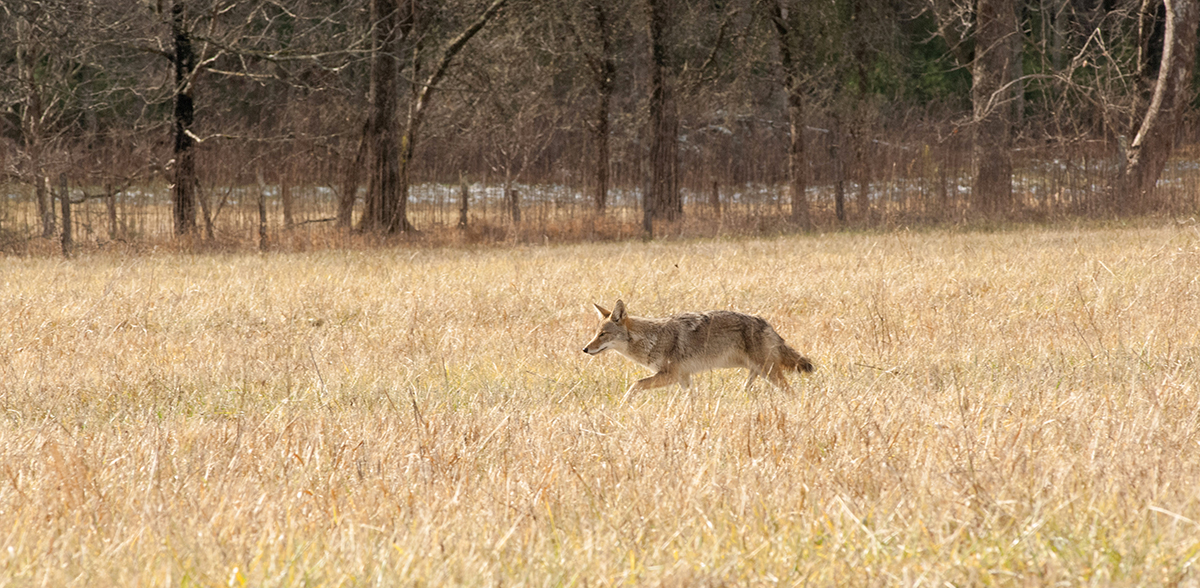
Coyote moving through a field in Cades Cove. North Carolina Wildlife Resources Commission
By Paula Musto
The bushy-tailed creature standing alone at the side of the road looked wary and out of place amid the evening traffic. Thinking it was a lost German Shepherd in need of help, I stopped the car. Only then did I realize it was not a dog at all, but a coyote—neither lost nor in distress. With one swift glance at its misguided rescuer, the animal sprinted into the woods.
“People commonly misidentify our wild canines,” says Falyn Owens, a wildlife biologist for the North Carolina Wildlife Resources Commission. “Coyotes, foxes and even dogs can appear similar from a distance. Coyotes are larger than foxes and smaller than wolves.”
Coyotes are generally about the size of a German Shepherd, but have long, slender snouts with a pointed nose. Lean and lightweight (usually 20 to 45 pounds), coyotes have a narrow chest and a more delicate build than the more muscular and broad-chested Shepherds. Another giveaway is the tail—the coyote carries it low while its canine cousin holds it higher.
For at least a decade now, coyotes have resided in urban areas across the state. Highly intelligent and adaptable, they range farther than any other canine on the continent and are found in every state in the continental US, roaming rural land and dense forests as well as downtown streets and residential neighborhoods.
Yet, coyotes, native to the Great Plains and American West, are relative newcomers to this part of country. Before the European settlement, they were primarily found west of the Mississippi River. However, starting in the 1800s, large-scale hunting and trapping decimated wolf populations—the coyote’s biggest competitor—clearing the way for coyotes to gradually move eastward. By the early 2000s, thriving populations had spread across North Carolina, including our mountains.
It’s a story of evolution adaptation in action, Owens says, driven largely by human-caused changes to the landscape. As wolves disappeared and forests gave way to farmland, coyotes found the opening they needed.
“A lot of wildlife species do not fare well when human development affects their habitat, but coyotes are doing just fine living side by side with us,” says Owens, who has studied the species for more than a decade. “They are opportunistic: capable of finding food and surviving almost anywhere.”
Much of their success comes down to appetite—coyotes will eat almost anything. Though primarily thought of as predators, they are in fact omnivores. They hunt small mammals including mice, squirrels and rabbits, along with birds, snakes and insects, but also consume berries and other fruits, seeds and nuts. If they have the opportunity, coyotes will happily devour people food, namely garbage and pet food left outdoors.
The eastern coyote’s history is written into their DNA. As coyotes wandered northward and eastward, some interbred with northern wolves, producing what are sometimes called coywolves. While they remain predominantly coyote, these animals carry small amounts of wolf DNA as well as traces of domestic dog. This genetic mix explains why eastern coyotes tend to be slightly bigger and more wolf-like than their western counterparts. Many coyotes, especially in the Northeast, have trace amounts of wolf ancestry, says Owens, though half-and-half hybrids are pretty rare.
Like many wild species, coyote populations are difficult to pin down. They roam widely and reproduce quickly, their numbers rising and falling with available food and terrain. People often overestimate how many are out there when they hear that distinctive howl: two or three animals can sound like a much larger pack as their rapid-fire cries, yips and barks reverberate through the hills and valleys.
Coyotes vocalize to defend territory and touch base with family members. Most often heard at dusk or just before dawn, the high-pitch calls can travel for more than a mile. The animals are heard more often than they are seen. Cautious by nature, they generally avoid people and, as I found, quickly move off if approached. That can change if the animal is injured, feels threatened or has pups nearby, so as with all wildlife, it’s best to keep a healthy distance.
For a closer look, the Western North Carolina Nature Center is a good place to observe coyotes. Cal and Walker, two three-year-old coyotes, came to the center as rescue pups. The duo are not biological brothers, according to Chesley Hollander, the coyotes’ care keeper, but have bonded as best friends.
“Coyote fur ranges in color from reddish brown and yellowish to gray and provides excellent camouflage in the wild,” says Hollander. “Cal and Walker, yellow with some gray patches, are typical of many coyotes in our region.”
The fall months are an excellent time to visit them in their heavily wooded habitat. The curious creatures will be happy to see you and, if you arrive early in the morning, they might even offer up a howl or two.
Paula Musto is a writer and volunteer for Appalachian Wildlife Refuge. For more information on the Western North Carolina Nature Center, visit WildWNC.org.