
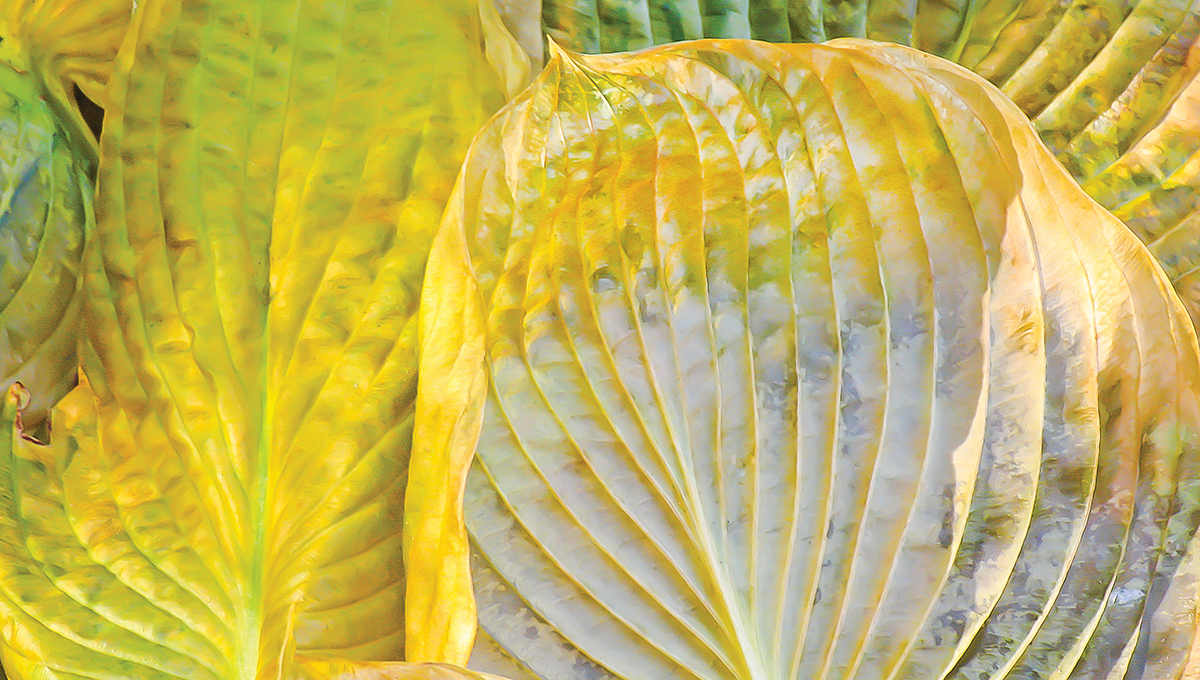
Hosta leaves in autumn. Photo by Judith Canty Graves
“Nature’s first green is gold, / Her hardest hue to hold. / Her early leaf’s a flower; / But only so an hour. / Then leaf subsides to leaf. / So Eden sank to grief, / So dawn goes down to day. / Nothing gold can stay.” ~ Robert Frost
By Judith Canty Graves
Impermanence is a concept in Buddhism asserting that life flows from one stage of existence to another. Change is constant. When we grasp and try to hold onto something, we will ultimately suffer because everything changes. Buddhism teaches that attachment is the cause of suffering and that we must be aware of impermanence in every aspect of our lives and try to accept it.
Gardens teach us about impermanence. Change is constant with soil, plants, weather and the natural world in general. We may think that something is stable and permanent, but the opposite is true. Sometimes the garden changes in ways that are small and imperceptible, but other times the changes are large and dramatic. Watching my garden change from season to season reminds me to embrace the changes in my own life and to fully appreciate every day.
I have had the privilege of observing the natural world closely for years. From day to day, not much seems to happen, but that can be an illusion. If I leave for two weeks on vacation, for example, I am always amazed at what I see when I return. One April, when I went away on a trip, the azaleas had not yet bloomed. When I returned, their pink flowers had burst open by the thousands! After a recent summer vacation, my plants had grown much taller and weeds had taken over everywhere.
All of the plants I grow illustrate impermanence. The transition from summer to fall is especially rapid and dramatic in the garden. The plants diminish, changing every day. The first killing frost happens at this time of year, marking the final end to the growing season for the warm weather plants.
I have to accept the reality that nature is constantly in the process of flowing from one stage of existence to the next, and that by November the time of growth has passed. It is time to lose my attachment to the garden I have nurtured for months. When the next cold front blows in, I will watch the clouds race overhead and reflect on the various aspects of the fall season, especially the bare branches that emerge from the trees, revealing their structure.
The branches symbolize our losses. Sometimes I feel wistful looking at them, remembering the lush growth of summer. Autumn shows us how fleeting the seasons are, but I know that life will continue to evolve and I feel at peace with the world. As one situation fades away, a new one will replace it, especially with growth in the spring.
There are many lessons we can learn from the natural world.
Judith Canty Graves is an Asheville gardener with a background in photojournalism. Follow @TheObservantGardener on Instagram to see new garden photos daily.


I follow this column from afar (NJ) and, although I am not a gardner myself, I enjoy the gardens of those who are. I always learn something interesting from The Observant Gardner.
This column was especially timely as I read it while sitting beside my 99 year old mother’s bedside in a rehab facility as she struggles to recover from injuries incurred from a fall. She has a strong will to survive, and I believe she will make it back home. But, in a diminished state. I know we’ve been blessed to have her with us so long, but she won’t live forever.
This column has me reflecting on the impermanence of human life, even as I observe the changes Mother Nature is spreading, rather dramatically, in the natural world outside.
Dear Judy,
I am sorry to read about your mother recovering from a fall. I hope she is doing better.
My column is about this universal truth of impermanence that exists everywhere in life. Of course, this includes human impermanence. Plants show us that life is constantly changing and it is fleeting. It can be difficult to accept this, but we must.
I am glad you are following my column every month and learning something interesting. Thanks for your comment.
JCG