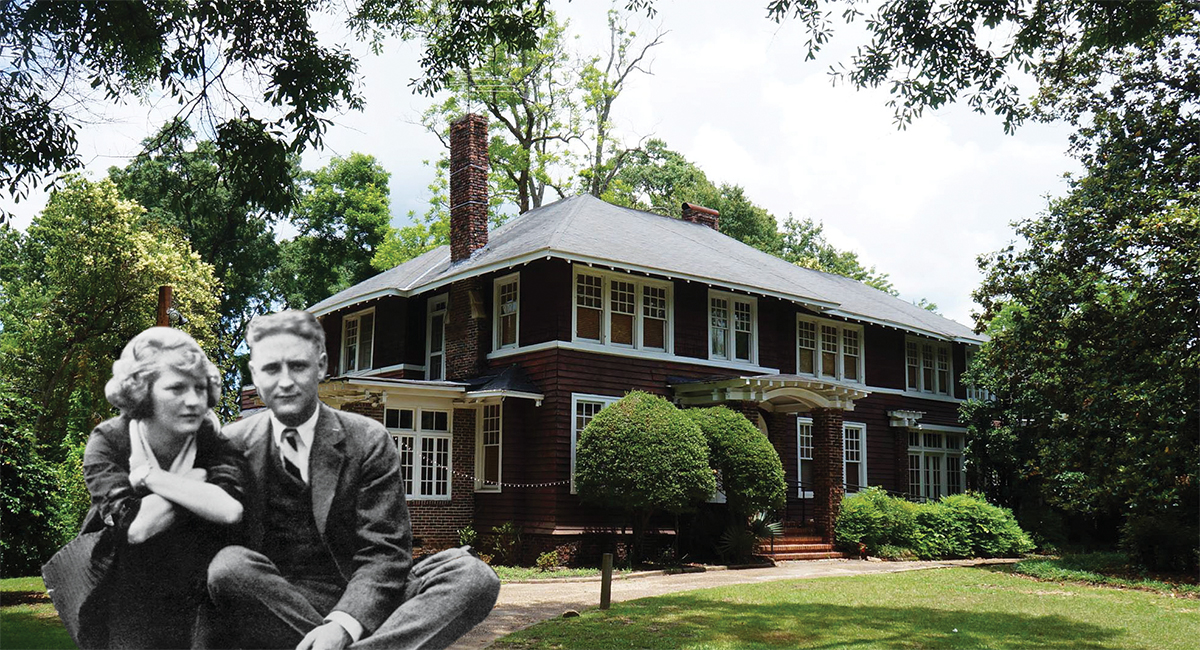
Photo courtesy of The Scott and Zelda Fitzgerald Museum
The annual remembrance of the life and accomplishments of Zelda Fitzgerald, who died tragically in Asheville’s Highland Hospital fire in 1948, will be held Thursday, March 7, through Sunday, March 10. Presented by Aurora Studio & Gallery, the 2024 Zelda Fitzgerald Events delve into aspects of Zelda’s high-profile life as a Jazz Age beauty, the wife of F. Scott Fitzgerald and, most importantly, an artist herself.
This is the ninth year that Asheville has celebrated Zelda’s life. It all began, says Lori Greenberg, founder and board president of Aurora Studio & Gallery, with one man’s vision. “Jim MacKenzie, a local advocate of literary works and history, approached me when he learned that I host a supportive art studio,” Greenberg says. “He strongly felt that Zelda’s artistry and life had been neglected by our community, given that she had lived on and off in Asheville the last 12 years of her life.”
In her lifetime, Zelda studied ballet, painted and wrote short stories and an autobiographical novel, Save Me the Waltz. When she died at age 47, she was a patient at Highland Hospital, a psychiatric facility. “The world owes homage to the many artists with lived mental health issues—whether literary, visual or performing—for expanding the understanding of the human condition through their work,” says Greenberg.
On March 7 at 6 p.m. at the Thomas Wolfe Memorial, Mark Taylor will discuss Scott Fitzgerald’s little-known work depicting an 8-day car trip the Fitzgeralds took in 1920. “One of the reasons why I think ‘The Cruise of the Rolling Junk’ is important is that it’s the piece of nonfiction writing where Scott really describes Zelda in the most detail,” says Taylor. “It’s also one of the pieces of writing that describes Zelda before her mental breakdown in 1930.” Taylor lives in Saint Paul, MN, where he gives walking tours of the neighborhood where Scott was born and spent much of his youth.
“I think it’s important to have events celebrating Zelda Sayre Fitzgerald in order to remember her importance as an artist in her own right, and not merely as ‘the wife of’ F. Scott Fitzgerald,” Taylor says. “Zelda was a deeply creative person, and it’s important for her artistic accomplishments to be remembered as well.”
On Friday, March 8, at 6 p.m., Dr. Alaina Doten, executive director of The Scott and Zelda Fitzgerald Museum, in Montgomery, AL, presents a talk titled “Zelda Fitzgerald: Her Lifelong Love of and Visits to Asheville” at AmeriHealth. From Zelda’s early childhood, her family summered in Asheville to escape Alabama’s heat. “In her later life, Zelda painted a number of landscapes of the area and was taken with Asheville’s natural beauty,” says Doten.
Doten’s grandmother grew up in Montgomery as a contemporary of the Fitzgeralds’ daughter Scottie and knew Zelda’s mother, Minnie Sayre. Family stories Doten heard never matched published accounts of Zelda’s life. “Zelda is much beloved both in the US and internationally, however, there are a great number of myths surrounding her and her story, especially in regards to her mental health and study of ballet,” she says. “We are working toward clearing up the myths regarding her and her family.”
At the East Asheville Branch Library on Saturday, March 9, at 1 p.m., NC State University film studies professor Dr. Marsha Gordon will discuss and sign copies of her new biography titled Becoming the Ex-Wife: The Unconventional Life & Forgotten Writings of Ursula Parrott, followed at 3 p.m. by a screening of “The Divorcee,” based on Parrott’s 1929 bestseller, Ex-Wife.
A discovery of a screenplay draft by Scott Fitzgerald of one of Parrott’s short stories introduced Gordon to Parrott and her work. She began by reading Ex-Wife. “I remember thinking that this is one of the best novels about life in New York City that I had ever read, and certainly one of the most frank engagements with issues facing women of the Jazz Age I had ever encountered, and why on earth wasn’t it in print and being taught in college and high school English classes,” Gordon says.
“Ursula and Zelda were part of the first truly modern generation in American history, during which women had more opportunities—and, as Parrott then observed, also faced more challenges—than at any prior point,” Gordon says. “They both embraced unconventionality and post-Victorian morality; they both struggled with alcohol and mental health. They had ambitions and were also searching for meaning and stability in a world that seemed, at best, impermanent.”
Events close on March 10, at 2 p.m. at Battery Park Book Exchange with A Literary Tasting with Monika Gross, during which individualized readings from Zelda’s writings will be paired with epicurean tastings. “I think it will surprise and impress listeners to learn that Zelda was herself such a strong and sure-handed writer with a unique voice whose work unfortunately has been overshadowed by the celebrity of her husband and the overly melodramatic narrative built up about her life since her death,” says Gross, artistic director of At-A-Site Theater.
Aurora Studio & Gallery’s mission is to provide supportive art workshops for artists and creatives who have been impacted by mental health needs, substance use disorder or those who have been unhoused. Learn more about the organization and Zelda Fitzgerald Events at AuroraStudio-Gallery.com.